Coming soon
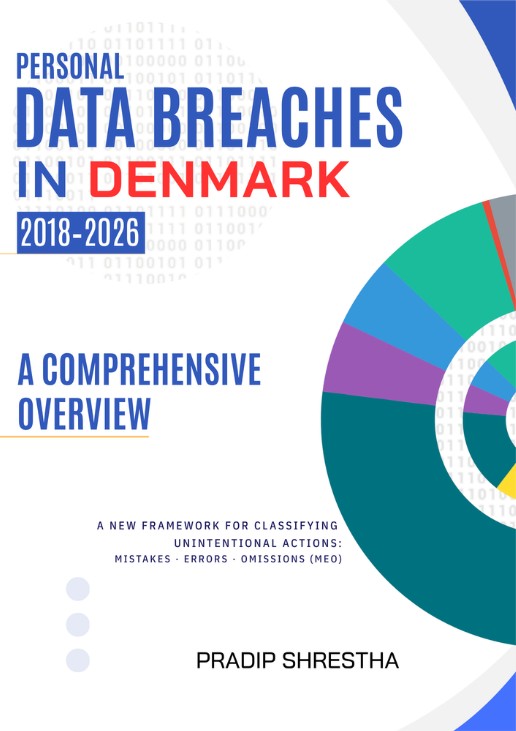
Personal Data Breaches in Denmark (2018–2026)
A Comprehensive Overview
Eight years of personal data breach notifications in Denmark, examined in seven chapters
Release status
Coming soon
The full edition is forthcoming. The release date will be announced on this page.
Latest progress
About the book
Personal Data Breaches in Denmark (2018–2026) examines how personal data breaches have been reported in Denmark since the GDPR became applicable across the EU. It draws on 68,454 breach notifications submitted to the Danish Data Protection Agency (Datatilsynet) between 25 May 2018 and 31 May 2026.
Part I sets out the foundations: how personal data is defined, classified, and processed under the GDPR and Danish rules, and the incident types Datatilsynet uses to record breaches. It also introduces the MEO Framework, which categorises unintentional incidents as Mistakes, Errors, or Omissions.
Part II analyses the notification data: the most common incident types, the sectors and industries that report most, and how the patterns have changed over eight years. It closes with practical measures for strengthening data security.
The book is written for privacy and cybersecurity professionals, legal and compliance practitioners, data governance teams, researchers, and analysts.
Source: Datatilsynet breach statistics, data as at 6 July 2026.
Read the pre-release edition
Personal Data Breaches in Denmark 2018–2026: The First Eight Years is a free companion to the book. It presents the main findings in eight short readings, based on 68,454 notifications submitted to Datatilsynet from May 2018 to May 2026.
Pre-release edition, version 1.0, August 2026
Preface
My journey in IT began in the mid-1990s with dBase V and FoxPro 2.6 and eventually led to my work as a cybersecurity and data lifecycle architect and to founding Alpha Data Consult. Throughout my career, I have worked extensively with data in various capacities, including managing personal, confidential, and sensitive data, often under strict regulatory requirements.
About the author
Pradip Shrestha has more than 25 years of experience helping organisations protect and manage their data. With a background in systems engineering and cybersecurity, he has led data-driven projects that improve organisational processes and protect personal data throughout its lifecycle.
As the founder of Alpha Data Consult, Pradip works closely with start-ups, non-profits, and organisations across sectors. He supports them from classifying their data to building secure systems aligned with the GDPR and related privacy rules. His work spans cybersecurity, data protection, and AI-enabled data tools, helping organisations remain resilient, compliant, and prepared in a changing digital landscape.
Pradip also holds a master’s degree in computer science, specialising in data security and protection. His commitment to continuous learning and professional development is reflected in his certifications:
- Data Privacy and Technology, Harvard Online (2024)
- Cybersecurity Architect Expert, Microsoft (2022)
- Azure Solutions Architect Expert, Microsoft (2019)
Pradip believes that data protection is not only a technical challenge but a shared responsibility. This book reflects that belief.
Inside the book
Seven chapters in two parts. Preview chapters will be linked here as they are released.
Part I. Foundations of Personal Data Protection
-
1
Denmark’s Digital Society and Personal Data Fundamentals
Forthcoming
This chapter provides the foundation for understanding the General Data Protection Regulation (GDPR) within the Danish context. It explains the core principles of personal data processing, data classification, and levels of sensitivity. It also distinguishes the main types of personal data breaches, covers breach notification, and outlines the proposed Single-Entry Point (SEP).
-
2
Incident Types and Risk Categorisation
Forthcoming
This chapter explains the incident types defined by the Danish Data Protection Agency (Datatilsynet) and the risks they pose to personal data. It then introduces the MEO Framework (Mistakes, Errors, and Omissions), which categorises unintentional breaches by failure mode. Together, the incident types and the MEO Framework help organisations understand how breaches occur and identify appropriate safeguards.
-
3
Sectors and Industries
Forthcoming
This chapter explains how the Danish Data Protection Agency (Datatilsynet) classifies data controllers by sector and industry. It also identifies the industries with the most reported personal data breaches between 2018 and 2026.
Part II. Personal Data Breach Trends and Sector Insights
-
4
Dataset Overview and Insights
Forthcoming
This chapter describes the source of the dataset used to analyse personal data breaches reported in Denmark. It explains the methodology for collecting and categorising the data to examine trends across sectors, industries, and incident types. It also addresses the dataset's limitations and their implications for interpreting the findings.
-
5
Summary of Findings
Forthcoming
This chapter summarises the key findings, highlighting major trends and recurring patterns in personal data breaches reported in Denmark. It identifies the most common incident types and the sectors with the most notifications, and provides an overview before the detailed analysis in Chapter 6.
-
6
Breach Patterns: Analysis and Interpretation
Forthcoming
This chapter examines the dataset across sectors and years, exploring the practical implications of the findings. It applies the MEO Framework to examine patterns of Mistakes, Errors, and Omissions in reported unintentional breaches. The results help organisations prioritise their data security measures.
-
7
Breach Insights and Measures: Strengthening Data Security
Forthcoming
This chapter brings together insights from earlier chapters to present a clear approach to protecting personal data throughout its lifecycle. It draws on the MEO Framework to explain why Mistakes, Errors, and Omissions require different safeguards. The chapter connects prevention, breach response, and organisational learning to help organisations strengthen data security in everyday practice.
Follow the book
Sign up to hear when new preview chapters appear and when the book is published. The sign-up form is on the Alpha Data Consult website.